Adult Scoliosis and Strength: How to Keep Doing What You Love
Maybe you’ve known about your curve since you were a teenager. Maybe a recent scan or a new ache brought the word “scoliosis” into your life for the first time. Either way, you’ve probably been handed some version of “just keep an eye on it” — and been left wondering what that actually means for the yoga class you love, the garden you tend, or the strength routine you were finally getting into.
Here’s something most people don’t realize: scoliosis is far more common in adults than the school-screening stereotype suggests, and it becomes more common with age as the spine naturally changes over time (peer-reviewed prevalence studies vary widely by how they measure). If you have a curve, you are in enormous company — and there is a lot you can do to keep moving well.
A ScoliBalance-informed coaching approach
A rehabilitation-focused doctor of chiropractic, Dr. Sam is also ScoliBalance certified, which means her approach to movement is informed by methods developed specifically with scoliosis in mind. Rather than a generic core routine, that means movement chosen thoughtfully for how your body is built — and progressed carefully, so you’re always working within a plan rather than guessing on your own.
Working with your medical team
Scoliosis in adults benefits from ongoing monitoring by your physician, and coaching fits neatly alongside that. You keep your medical care and your check-ups; you add strength and movement guidance that helps you stay active and confident between them. It’s a partnership, not a replacement.
- Movement chosen for your body, informed by scoliosis-specific methods
- Focused on strength, function, and confidence — not curve-change promises
- Delivered virtually and coordinated with your physician’s monitoring
A curve in your spine is not a reason to shrink your life. With the right support, it can be a reason to get stronger, on purpose.
KEY TAKEAWAYS
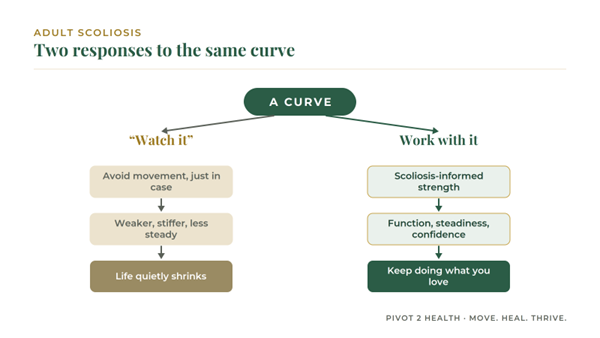
- Adult scoliosis is common and usually stable — “watch it” is a plan for the spine, not for the person.
- Fear-driven avoidance backfires: a body that stops moving gets weaker and stiffer, not safer.
- The goal is function and confidence — not changing the curve on an X-ray.
Scoliosis-informed coaching (ScoliBalance) complements your physician’s monitoring; it doesn’t replace it.
FREQUENTLY ASKED QUESTIONS
Is it safe to exercise or lift weights with adult scoliosis?
For most adults with a stable curve, thoughtful strength training is not only safe — it’s one of the best ways to stay supported and confident. The key is a plan matched to how your body is built and progressed gradually, ideally alongside your physician’s monitoring. Avoidance is usually the bigger risk.
Can exercise straighten or fix my scoliosis curve?
Coaching does not make claims about changing your curve, and you should be cautious of anyone who promises that. The realistic, worthwhile goal is function: standing and sitting more comfortably, moving with more steadiness, and feeling strong rather than fragile.
What is ScoliBalance?
ScoliBalance is a scoliosis-specific approach to exercise. A ScoliBalance-informed program selects and progresses movement with the realities of a curved spine in mind, rather than applying a generic core routine.
Do I have to give up yoga, hiking, or the activities I love?
Usually not. The aim is to keep doing what you love with more strength and less fear — modifying intelligently where needed, not shrinking your life around the diagnosis.
If you’ve been “keeping an eye on it” and quietly wondering whether you’re allowed to be strong, start with a complimentary 15-minute evaluation. We’ll talk through where you are and what a scoliosis-informed plan could look like for you.
Get The Pivot in your inbox — CLICK HERE
Leave a Reply
Want to join the discussion?Feel free to contribute!